In this article
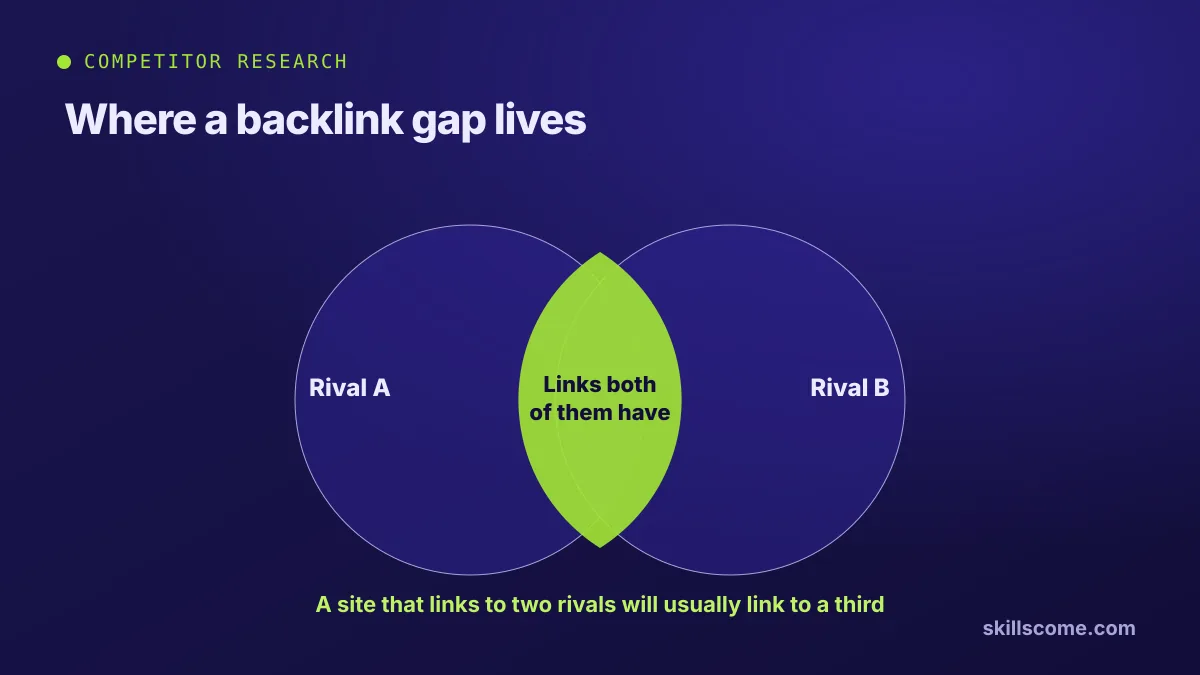
A backlink gap analysis compares your link profile against two or three competitors and returns the sites that link to them and not to you. That list is the most useful link prospecting document in SEO, because every site on it has already proved it will link to a business like yours.
What a gap analysis is
Every backlink tool has the feature, usually called link gap, backlink gap or link intersect. You give it your domain and two to four competitors, and it returns referring domains sorted by how many of them each site links to.
The rows at the top, the sites linking to all of your competitors but none of your pages, are the ones to read first.
Why the overlap matters
Cold link outreach has a miserable response rate because most of the sites being emailed have no history of linking to anyone. A gap list inverts that. Each site on it has already made the decision you want it to make, for a business that competes with you.
It also tells you something about your market that nothing else does. If all three of your competitors have links from the same five trade publications, those publications are the gatekeepers in your niche, and that is worth knowing even if you never email them.
The signal to look for
A site linking to one competitor might be a coincidence. A site linking to three is a pattern, and patterns are what you work.
How to run one
- Pick the right competitors. Not the biggest names in your industry. The sites that actually appear above you for the terms you want. Search your three main terms and take whoever keeps showing up.
- Use three or four, not one. One competitor gives you their whole profile, which is noise. Three gives you an intersection, which is a pattern.
- Compare at domain level, not URL level, for the first pass. You want to know which sites link to them, not which exact pages.
- Filter out the obvious. Directories everyone is in, social profiles, and anything you could get in five minutes are not insights. Remove them.
- Sort by how many competitors each site links to, highest first. Work from the top.
Reading the list properly
A raw gap list has three kinds of row mixed together, and treating them the same wastes most of the value.
- Reachable. Industry blogs, trade sites, supplier pages, local press, roundups and resource lists. These are the ones to work. They link to businesses like yours because that is what their readers want.
- Structural. Directories, review platforms, association registers. Usually just a matter of signing up and filling in the details. Low value each but quick, and they are table stakes in some markets.
- Unreachable. National newspapers, links that came from a funding round, mentions tied to an event you were not part of. Note them and move on. They explain the gap, they do not close it.
Before you email anything, open the actual page the competitor link sits on. You are looking for how the mention came about, because that is the thing you need to reproduce. A product roundup, a case study, a supplier directory and an interview all need entirely different approaches.
Turning it into placements
The list is prospects, not links. What converts them is having something specific to offer the site, which usually means one of:
- You belong in a list they already publish. The easiest ask in link building, because the page exists and you qualify.
- Their page is out of date and you can tell them precisely what changed, politely, without making them feel stupid.
- You have data they do not. Numbers from your own operation are the one thing a competitor cannot copy.
- You can write something their readers want, which is the guest post route, and it works when the site is real and the piece is good.
Expect a low hit rate even here. A gap list of eighty reachable sites might turn into eight or ten placements over a quarter. That is a good quarter.
What it will not tell you
A gap analysis cannot tell you whether a link is worth having, only that a competitor has it. Competitors buy bad links too, and a list full of the same link farm is a list of what not to do. Judge each site yourself before adding it to a target list.
It also cannot tell you whether links are your problem at all. If your pages are not indexed, or they answer the search worse than the ones ranking, the gap list is a distraction. How many backlinks you need to rank covers how to check which situation you are in first.
Running this at scale, across a large pool of niche sites rather than three competitors, is the idea behind the Nandla link strategy we use on client campaigns.

Ijaz ul Haq
Founder of SkillsCome. Doing SEO since 2021, with 500+ SEO projects delivered and Top Rated status on Fiverr and Upwork. Runs and ranks his own stores in English, Spanish and Turkish.