In this article
Nobody can tell you how many backlinks you need, and anyone who gives you a figure without looking at your competitors is making it up. The honest answer is that it depends entirely on the page you are trying to outrank, and you can find that out in about twenty minutes.
What follows is how to work it out, and why the count matters far less than most people hope.
The short answer
You need roughly as many relevant links as the pages currently ranking for your term, and you need them from the kind of sites those pages have. For a local service page that can be three or four. For a competitive commercial term it can be hundreds, built over years.
That range is not a dodge. It is the actual shape of the answer, and it is why generic numbers like "you need 50 backlinks" are worthless.
The only number that matters
Not how many links you have. How many relevant links the page in position three has, and whether you can realistically get the same.
Why the question is the wrong shape
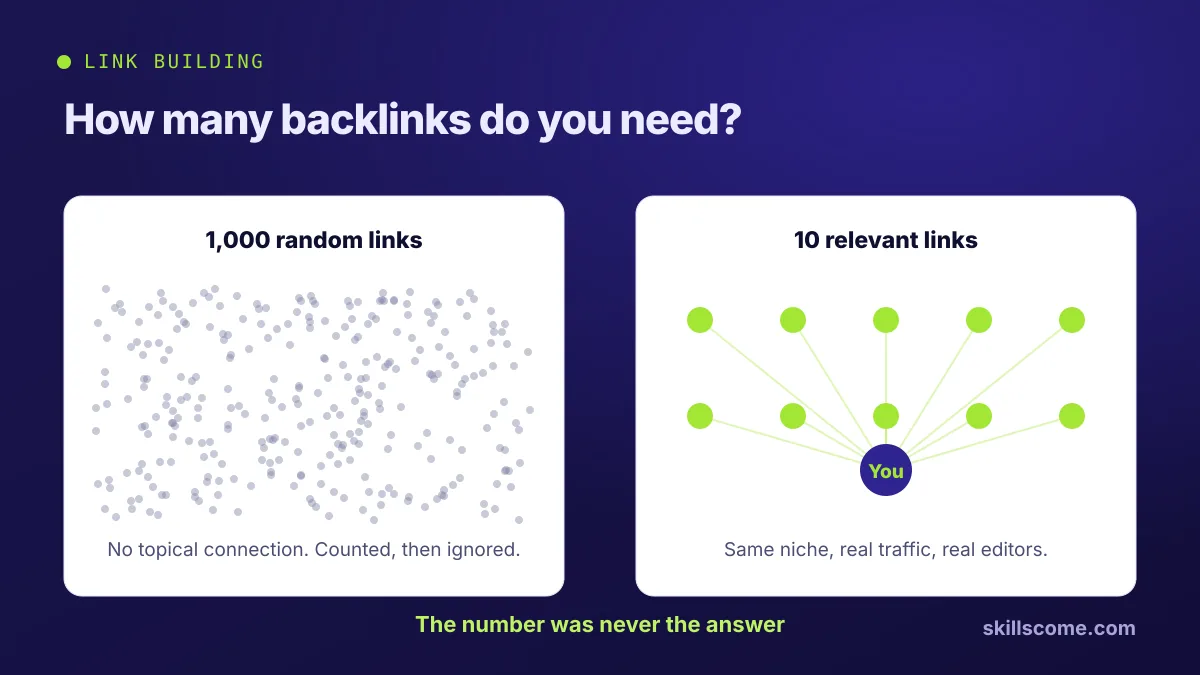
Google does not count links the way a spreadsheet does. A link is a signal, and signals are weighted. One mention in an industry publication your buyers actually read can outweigh several hundred directory entries, profile pages and blog comments, because the first one is evidence that somebody with a reputation chose to point at you.
So two sites with identical link counts can sit five pages apart. The count tells you almost nothing on its own. What matters is:
- Relevance. Is the linking site about anything close to your topic? This is the single biggest divider between links that move a page and links that sit there.
- Where on the page. A link inside the body of an article is read differently from one in a footer that appears on every page of the site.
- How many links share that page. A page with 5,000 outbound links is dividing whatever it has 5,000 ways.
- Whether the page is indexed at all. If Google has never indexed the page your link sits on, the link does not exist as far as ranking is concerned. We wrote about that in how to get backlinks indexed.
How to find the real number for your page
This is the part most guides skip. You do not need a target number, you need a target page.
- Search your term in a clean browser window, set to the country you sell in. Private mode is enough. Write down the top five results.
- Ignore the giants. If Amazon, Wikipedia or a government site is sitting in the top three, skip them. You are not beating those and you do not need to. Look at the first result that is a business like yours.
- Check the referring domains for that specific page, not the whole site. This is the number that matters, and it is almost always far smaller than the site total. Any backlink tool will show it.
- Look at who those sites are. If they are industry blogs, trade press and suppliers, the gap is closable. If they are national newspapers, the gap is a budget question, not an SEO question.
- Add a margin. Aim for a similar count from similar sites, plus a few, and assume it takes months rather than weeks.
If you do this for five terms you will notice something useful: the easy terms often need fewer than ten links, and the hard ones need more than you were ever going to buy. That is your keyword strategy, discovered through link data.
What one good link is worth
There is no exchange rate, but the practical experience across our own sites and client work is consistent. A single editorial mention on a site in the same niche, with real traffic, placed inside an article that people read, will do more than fifty placements bought in a bundle.
The reason is not mystical. The bundle links usually sit on pages built only to hold links, those pages attract no traffic, nobody else links to them, and Google has seen the same footprint thousands of times. The editorial mention sits on a page that exists for its own reasons.
A test you can run yourself
Before accepting any link, open the page it will sit on and ask whether a real person would ever land there from search. If the answer is no, the link is decoration.
How many per month is safe
People ask this because they have heard about link velocity, and the fear is reasonable. A site with nine links that suddenly gains four hundred in a fortnight has told Google something about how those links were obtained.
There is no published limit, and Google has never given one. What we run on our own projects, and on client campaigns, is a pace that stays proportional to the site:
- A new site with little history: a handful a month, growing as the content does.
- An established site already earning links: whatever it earns naturally, plus a similar amount built deliberately.
- Never a large block all at once, even if the links are good ones. Spread them.
This is the whole idea behind a monthly link drip: the same hundred links placed over four months behave differently from a hundred placed in a week, and the slower version survives updates.
What usually matters more
Here is the part that costs agencies money to admit. On most small and mid sized sites we audit, links are not the bottleneck. The bottleneck is that Google has not indexed half the pages, or the pages that are indexed answer the search worse than the ones already ranking.
Building links to a page that does not deserve to rank is expensive and slow. Fixing the page first, then building a smaller number of relevant links, is cheaper and faster. If you are not sure which situation you are in, start with the indexing report: why half your pages are not indexed walks through it.
So the real answer to how many backlinks you need is this. Find the page you want to beat, count its referring domains, judge whether you can get similar ones, and then check that your own page is worth the links before you build any.

Ijaz ul Haq
Founder of SkillsCome. Doing SEO since 2021, with 500+ SEO projects delivered and Top Rated status on Fiverr and Upwork. Runs and ranks his own stores in English, Spanish and Turkish.