In this article
For a backlink to do anything, Google has to have the page it sits on in its index. If the page was never indexed, or dropped out, the link is invisible and passes nothing. This is one of the quietest ways link budgets get wasted.
Why it matters
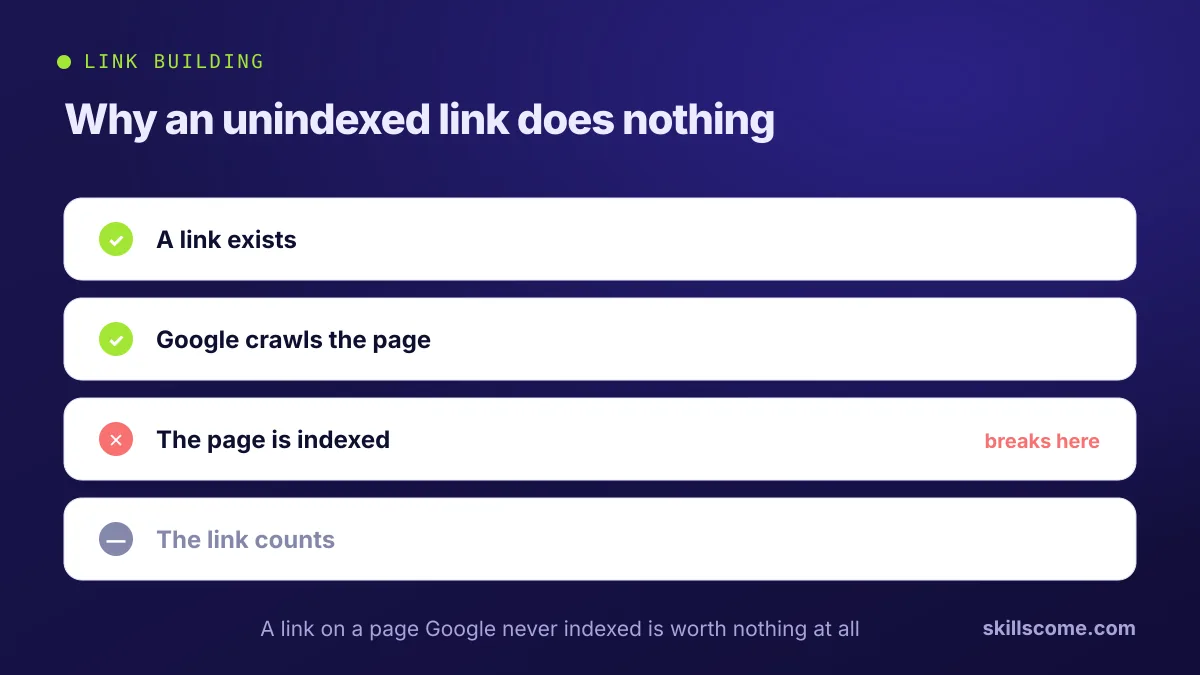
The chain is simple and every step has to hold. The link exists, Google crawls the page, Google indexes the page, the link counts. Break the third step and the first two were pointless.
This is especially common with bought links, because the pages they sit on exist only to hold links. Nobody reads them, nobody else links to them, and Google often decides they add nothing to the index. The link is live, your report says so, and it is worth nothing.
How to check
Take the URL of the page your link sits on and search Google for it directly, wrapped in a site query or just pasted into the search box in quotes. If the page comes back, it is indexed. If nothing comes back, it is not.
Do this for every placement you paid for. On a list of forty bought links it is not unusual to find a third of the pages missing from the index entirely, and that is a conversation worth having with whoever sold them.
A quicker read
If the whole domain returns almost nothing in a site search, the problem is not your page. The network has been deindexed, and no amount of pinging will fix it.
Why a page is not indexed
- It has no value to the index. A page of outbound links with no readers is exactly what Google filters out. This is the most common reason and the hardest to fix.
- Nothing links to it. Orphan pages on a site Google rarely crawls can sit undiscovered for months.
- The site is deindexed. A link network that got caught takes all of its pages with it.
- It is blocked. A noindex tag, a robots.txt rule, or a canonical pointing somewhere else.
- It is genuinely new. Give a real site a few weeks before deciding anything.
Only the last two have clean fixes. The first three are telling you something about the quality of the placement.
What actually works
You cannot force Google to index someone else's page, and anyone claiming otherwise is selling something. What you can do is improve the odds, in rough order of how well it works.
- Ask the site owner to link to it internally. A page linked from the site's own navigation, category listing or a recent article gets crawled. One sentence in an email, and it is the single most effective thing on this list.
- Check the page is in their sitemap. Often it is not, and often they can add it.
- Link to it yourself from somewhere Google crawls often. A mention from an active social profile or a resource page on a site you control gives the crawler a path. Modest effect, costs nothing.
- Give it time. Six to eight weeks on a legitimate site is normal.
- Stop buying from that source. If a supplier's pages routinely fail to index, that is the finding, and it is worth more than any individual link.
Indexing services, honestly
There is a market for tools that promise to force links into the index, usually by pinging, by building secondary links, or by submitting through an API. Our experience, and the general experience, is that they mostly work on pages that were going to be indexed anyway.
The reason is straightforward. Google is not failing to find these pages, it is choosing not to keep them. A ping does not change that judgement. If anything, blasting secondary links at a thin page makes the pattern more obvious rather than less.
Spend the money on a link from a site that gets indexed by default, because it is a real site with real readers.
Avoiding it next time
Add one line to the check you run before accepting any placement: search the domain in Google and see how much of it is actually in the index. A site with a hundred pages and four indexed is not a site, it is a shell.
Then add indexing status as a column in your tracking sheet, checked a month after each placement goes live. How to manage backlinks sets out the rest of that routine.
And if the links are indexed and still nothing has moved, that is usually a timing question rather than a technical one. How long backlinks take to work covers what to expect and when.

Ijaz ul Haq
Founder of SkillsCome. Doing SEO since 2021, with 500+ SEO projects delivered and Top Rated status on Fiverr and Upwork. Runs and ranks his own stores in English, Spanish and Turkish.