In this article
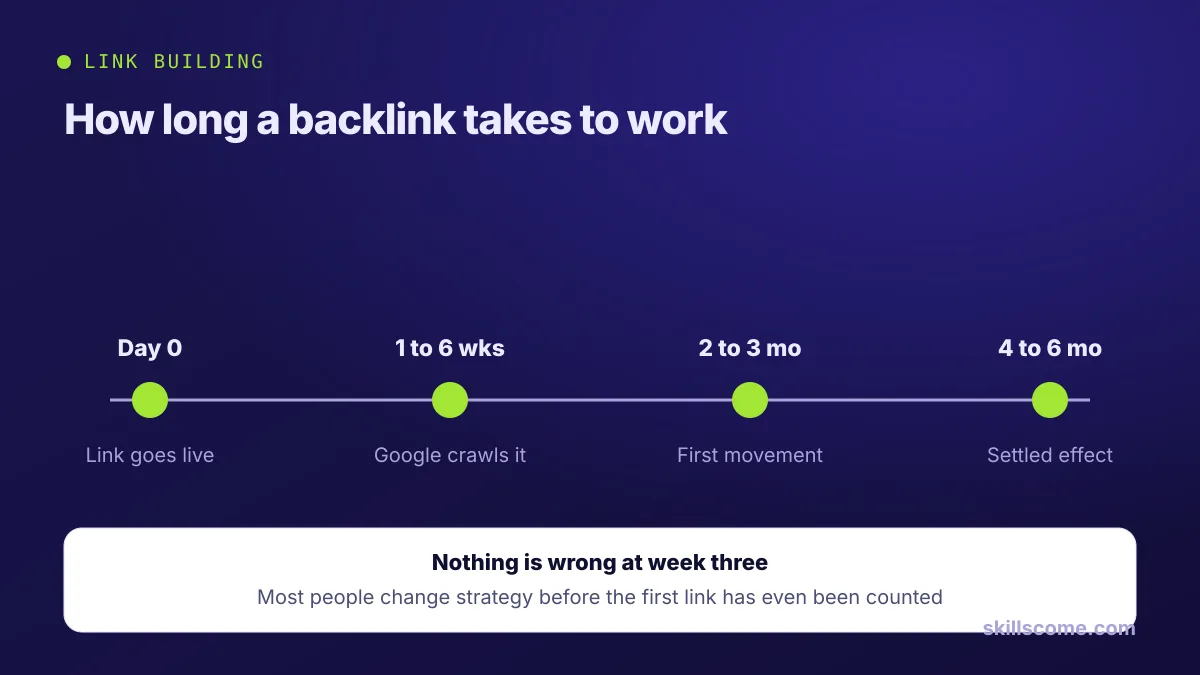
Expect one to six weeks before Google counts a new link at all, and two to three months before you can reasonably look for movement in rankings. On competitive terms the full effect can take six months or longer.
That is slower than most people are told when they buy, and the gap between expectation and reality is why so many campaigns get abandoned at exactly the wrong moment.
The short answer
A link does nothing until Google has crawled the page it sits on. Then it does nothing visible until that signal has been processed alongside everything else pointing at your page. Then the effect shows up gradually, not as a step.
On a page already sitting on the second page of results, a few good links can move things within a month or two. On a page nowhere near the top hundred, links are not the reason it is not ranking, and no amount of them will be fast.
What happens at each stage
Day zero to six weeks: crawling
The link exists but Google has not seen it. How long this takes depends almost entirely on the linking site. A busy news site is crawled hourly. A dormant blog might be crawled twice a year. If the page never gets indexed, the clock never starts, which is covered in how to get backlinks indexed.
Six weeks to three months: counting
The link is known and is being weighed with everything else. This is where most of the apparent nothing happens. Rankings may wobble slightly without any clear direction, which is normal and not a signal of anything.
Two to six months: movement
If the links were relevant and the page deserved to rank, this is where you see it. Usually in impressions first, then average position, then clicks. Checking impressions rather than rankings gives you the earliest honest read.
Six months and beyond: settling
The effect stabilises. Some of it fades if links are lost, some compounds as the page picks up links of its own.
What to watch instead of rankings
Impressions in Search Console move before position does. A page gaining impressions at position 40 is working, even though nobody has clicked it yet.
What makes it faster
- The linking page is crawled often, because it is on an active site that publishes regularly.
- Your page is already close. Moving from 15 to 8 is much faster than moving from 90 to 40.
- The link is topically close to your page. Relevance speeds up the effect as well as increasing it.
- Your site has some history. Established domains tend to show movement sooner than ones registered last month.
- The link sends real traffic. Not a ranking factor on its own, but a link people click is usually the kind that counts.
What makes it slower
- A brand new domain. New sites take months to establish anything, with or without links.
- The page is not indexed, yours or theirs.
- The target page is weak. Links pointing at a thin page do not make it a good answer.
- A competitive term where everyone above you is also building links.
- A core update landed mid campaign and reshuffled everything, which makes before and after comparisons useless for a while.
How to tell it is not working
Give it four months, then ask three questions.
- Are the links actually live and indexed? Open them. A third of bought links commonly fail this.
- Have impressions for the target page moved at all? Not clicks, not position. Impressions. Flat impressions after four months of real links usually means the page, not the links, is the problem.
- Are the links relevant? If the answer is no, the campaign was never going to work and the time was the smaller loss.
If impressions have moved and position has not, keep going, it is working and it is early. If nothing has moved at all and the links are good, the problem is upstream: either indexing, or a page that does not answer the search as well as the ones ranking.
This is also why we place links at a steady monthly pace rather than in one block. How many backlinks you need to rank covers how to size a campaign, and the monthly link drip is how we run them.

Ijaz ul Haq
Founder of SkillsCome. Doing SEO since 2021, with 500+ SEO projects delivered and Top Rated status on Fiverr and Upwork. Runs and ranks his own stores in English, Spanish and Turkish.