In this article
Backlink management is not a tool, it is a habit. Links you paid for get deleted, redirected, marked nofollow or quietly stripped during a site redesign, and nobody emails to tell you. A site that never checks is paying for placements that stopped existing months ago.
The routine below takes under an hour a month on a normal site, and it is the same one we run for clients.
Why links rot
The disappearance rate surprises people. Over a year, a meaningful share of any built link profile stops working, and almost none of it is announced. The usual causes:
- The site redesigned and the old article did not survive the migration.
- An editor cleaned up and stripped outbound links from old posts.
- The link became nofollow when the site added a plugin or changed policy.
- The page is still there but fell out of the index, which has the same effect as deletion.
- The domain expired and now points somewhere else entirely, sometimes somewhere you would rather not be associated with.
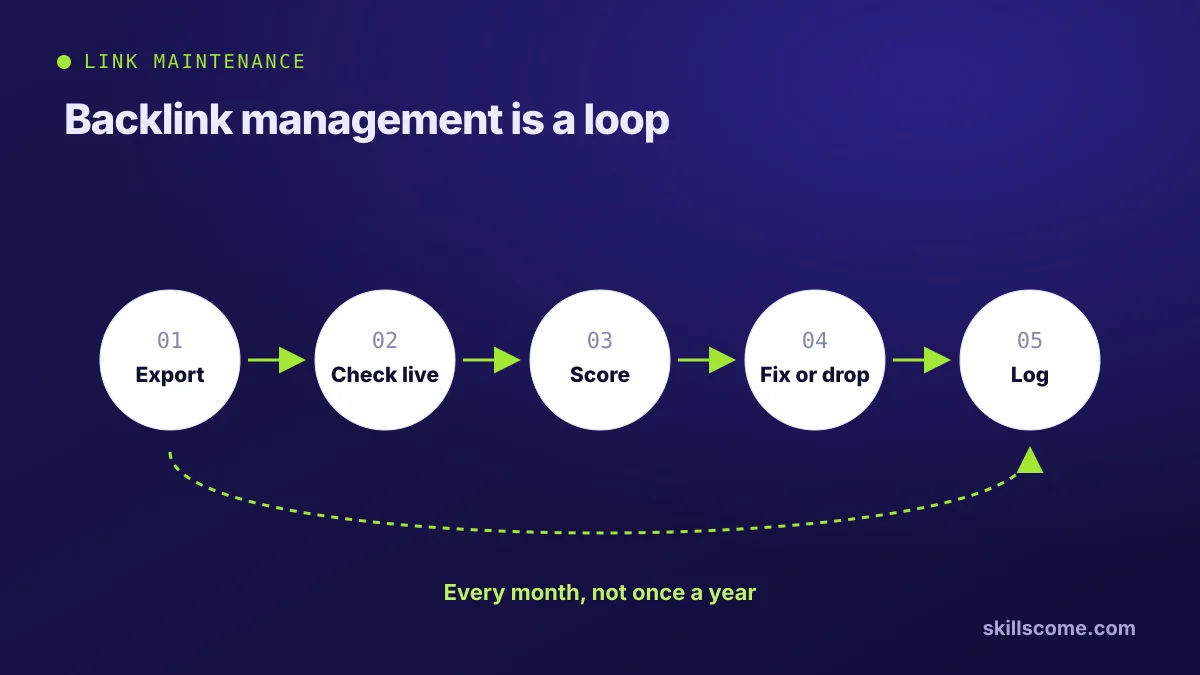
The monthly loop
1. Export
Pull the current referring domains list from whichever tool you use, into a sheet. Same tool every month, so the numbers are comparable. Changing tools mid campaign makes every trend meaningless.
2. Check what is still live
Take the links you built deliberately and open them. Not all of them, every month, forever. Check anything you paid for, anything from the last ninety days, and a sample of the older ones. You are looking for three things: is the page still there, is your link still in it, and is it still followed.
3. Score
Mark each one as keep, watch or drop. Keep is a relevant site with real traffic. Watch is thin but harmless. Drop is a site you would be embarrassed to show a client. This is a judgement call and it should stay one.
4. Fix or drop
For a link that went missing, email the site once and ask. A polite note to an editor recovers more links than people expect, because the removal was usually accidental. For anything you have marked drop and cannot remove, note it and move on.
5. Log it
Write down what changed this month. Which links went live, which disappeared, which you recovered. Six months of this is the only honest record of whether your link building is working.
Why the log matters most
Without it, every conversation about link building becomes an argument about memory. With it, you can see that forty links were placed and eleven are gone, and decide accordingly.
What to keep in the sheet
Keep it boring. One row per link, with:
- The page the link sits on, as a full URL
- The page on your site it points to
- The anchor text used
- The date it first went live
- Followed or nofollowed
- How it was obtained, and what it cost
- Status, updated each month
That last column is the one that earns its place. Anyone who has run link building for a year without it has lost track of something.
What to do about a lost link
Work in this order, because the cheapest fix comes first.
- Check it is actually gone. Sometimes the tool is wrong, or the page moved and the link came with it.
- Check your own end. If the target page returned a 404 or was redirected badly, the link may be fine and your site broke it.
- Ask once. A short, specific, friendly email to whoever runs the site. Mention the article, mention the link, do not lecture them.
- Replace rather than chase. If there is no reply after a follow up, let it go. Time spent recovering one link is usually better spent earning another.
Tools, and when you do not need one
Under about thirty built links, a spreadsheet and a browser do the whole job and cost nothing. Above that, a backlink tool saves real time, mostly on the export and the live check.
What no tool does well is the judgement in step three. Relevance is a human call, and a tool that scores a site highly because it has a lot of links is answering a different question than the one you asked. Keep the scoring manual.
If this is more upkeep than you want to own, it is part of what we do on the monthly link drip, where every placement is reported with its live URL so you can open each one yourself. And if you are starting from a profile you did not build, what a backlink profile is made of is the better first read.

Ijaz ul Haq
Founder of SkillsCome. Doing SEO since 2021, with 500+ SEO projects delivered and Top Rated status on Fiverr and Upwork. Runs and ranks his own stores in English, Spanish and Turkish.