In this article
Your backlink profile is the full set of links pointing at your site, described by their character rather than their count. When a tool scores it, or an agency says yours looks unnatural, they are talking about a pattern, not a total.
It is worth understanding properly, because it is the one part of SEO where a site can go backwards by doing more work.
What the term means
Picture every site that links to you, laid out together. Some are in your industry, some are not. Some mention your brand name, others use a keyword. A few arrived last week, most have been there for years. That whole shape is the profile.
Google does not evaluate links one at a time in isolation. It looks at the pattern, because the pattern is much harder to fake than any single link. A profile built honestly looks irregular, slow and topically clustered. A bought one looks even, fast and scattered across unrelated subjects.
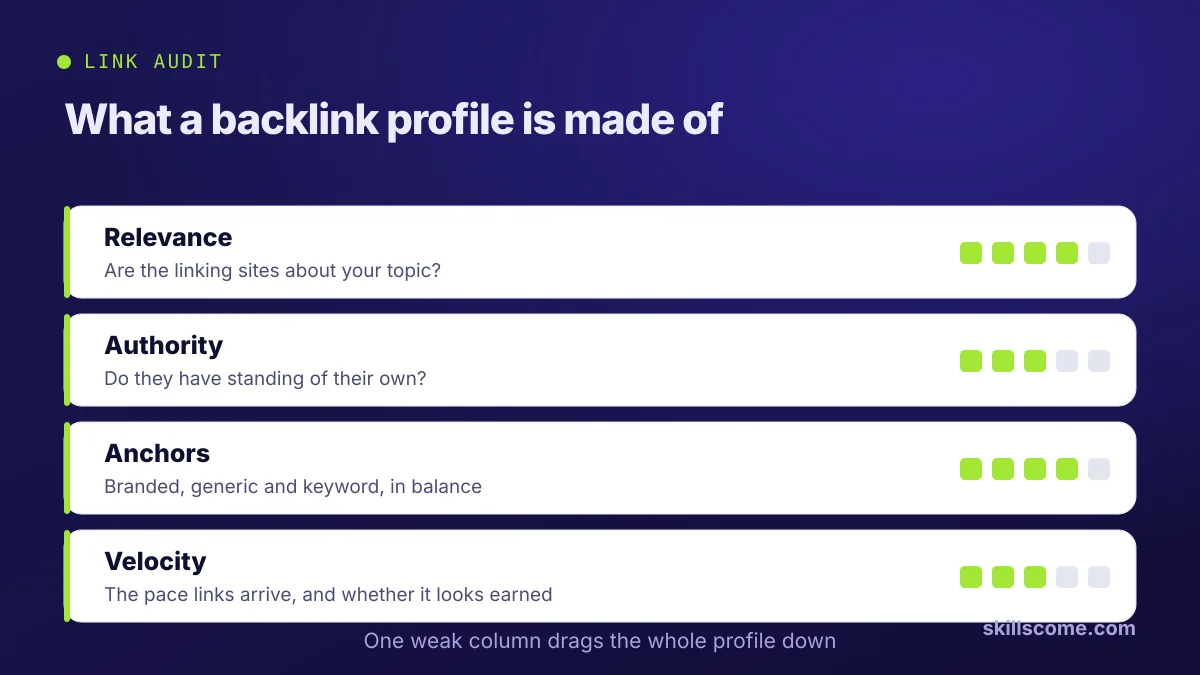
The four things it measures
Relevance
Are the sites linking to you about anything connected to what you do? A bakery with links from accountancy blogs, casino sites and Turkish forums has a relevance problem no amount of authority fixes. This is the measure that moved furthest up the list over the past few years.
Authority
Do the linking sites have standing of their own, meaning other people link to them too? Authority scores from tools are estimates and should be treated as such, but the underlying question is real. A link from a site nobody links to passes on very little.
Anchor text
What words are used in the links? A natural profile is mostly brand names, bare URLs and phrases like "this guide" or "their write-up", with keyword anchors as a minority. When sixty per cent of your anchors are the exact term you want to rank for, that is a pattern no editor produces by accident.
Velocity
How fast are links arriving, relative to the site's history? Growth is fine and expected. A flat line followed by a vertical spike is a story about procurement, not popularity.
The common failure
Most damaged profiles we see are strong on authority and completely broken on relevance, because authority is the one metric the cheap link market sells on.
How to read your own in ten minutes
You do not need an expensive subscription for a first look. Any backlink tool with a free tier gives you enough to spot the obvious problems.
- Open the referring domains list, not the backlinks list. One site linking a hundred times is one relationship, not a hundred.
- Sort by first seen, newest first. Look at what arrived in the last three months. Do you recognise any of it? Did you ask for it?
- Scan the domain names. If you see gambling, pharmacy or adult sites in a profile for a plumbing business, you have found something worth reading about in our piece on toxic backlinks and when to disavow.
- Open the anchor text report. Count roughly what share is your brand name versus a money keyword. Brand should win comfortably.
- Click five links at random and actually visit the pages. This is the step everyone skips and it tells you more than the other four together.
What a damaged profile looks like
A few patterns show up again and again in audits:
- Hundreds of domains, almost all registered in the same few months. Usually an automated network, often not even built by the site owner.
- The same sentence as the anchor across dozens of sites. One template, one operator.
- Sitewide footer links from a web designer or a supplier, appearing on every page of their site. Harmless at a small scale, odd at a large one.
- No brand anchors at all. Real people link using your name. Nobody writes "cheap plumber london" as a sentence.
- A profile that is all links and no mentions. Genuine coverage usually brings unlinked mentions too.
What to do about it
Less than most people expect. If the bad links were not built by you or on your behalf, Google is very good at ignoring them and the usual correct action is to do nothing at all. If they were bought, the honest route is to get them removed where you can, and disavow the rest.
Then stop treating the profile as a number to grow. Build fewer links, from sites that have something to do with your subject, at a pace the site can explain. That is the whole of it, and it is what our off-page work consists of.
If you want to know roughly how many you are aiming for, how many backlinks you need to rank covers how to work it out from the pages you are trying to beat.

Ijaz ul Haq
Founder of SkillsCome. Doing SEO since 2021, with 500+ SEO projects delivered and Top Rated status on Fiverr and Upwork. Runs and ranks his own stores in English, Spanish and Turkish.