In this article
A toxic backlink is a link from a site that exists to manipulate rankings rather than to inform anyone. Link farms, automated blog networks, hacked pages, gambling and pharmacy spam, and the endless auto generated "buy backlinks" pages that scrape domain names and publish them as fake testimonials.
They look alarming in a tool. In most cases the correct response is to do nothing, and this piece is mostly about why.
What a toxic backlink is
The patterns are consistent once you have seen a few:
- Pages with thousands of outbound links, often five thousand or more, all to unrelated businesses.
- Templated titles, where the same sentence appears across dozens of domains with one word swapped.
- Irrelevant niches. Casino, adult and pharmacy domains linking to a plumber, an accountant or an SEO agency.
- Fake testimonials that mention your domain in a sentence nobody wrote, such as a precise percentage improvement you never reported.
- Domains registered in a burst, all within a few weeks of each other.
How to find them
Open any backlink tool, go to referring domains, and sort by first seen with the newest at the top. You are not looking for a toxicity score. You are looking at domain names and at the pages themselves.
Scores are worth very little here. Tools flag links as toxic using their own models, and those models routinely flag perfectly normal small sites while missing sophisticated networks. Read the list yourself. It takes ten minutes and it is the only reliable method.
The one question that decides it
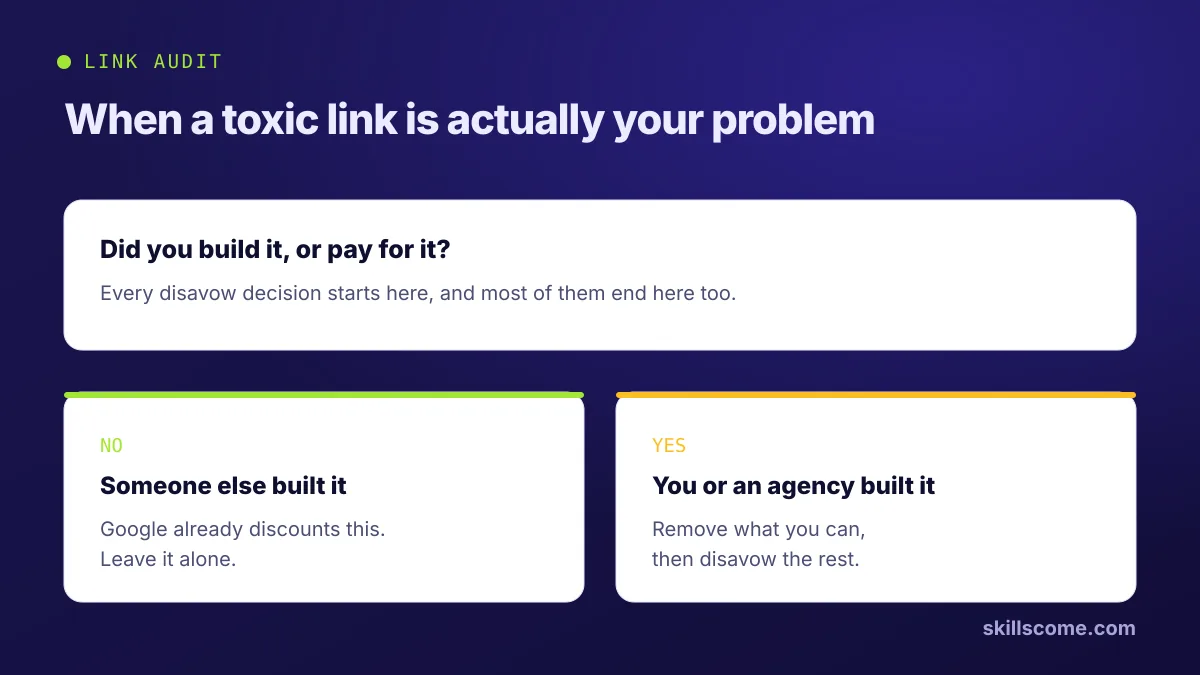
Here it is: did you, or anyone working for you, build or pay for these links?
If no, leave them alone. Google's systems were built to ignore exactly this, because if spam links could damage a competitor, every business on the internet would be attacking every other business. Google has said plainly that the disavow tool is for links you are responsible for.
If yes, that is different. Those links are evidence of a deliberate attempt to manipulate rankings, and they are worth cleaning up, particularly if you have a manual action in Search Console.
The honest position
Most sites should never touch the disavow tool. It exists for a narrow case: links you bought, or a manual action you are trying to get lifted.
A worked example from this site
This site launched at the end of October 2026. Within a few days of looking, its backlink profile showed 146 links from 131 referring domains, every one of them first seen between late August and the end of October, which is to say before the site existed.
The sources were gambling domains, Turkish escort sites, pharmacy spam, and dozens of auto generated pages with titles like "Professional Manual Outreach Backlinks for this domain to Improve Citation Flow", each carrying five thousand outbound links and an authority score of zero. There were also fake testimonial pages claiming the site had improved somebody's bounce rate by 45 per cent.
None of it was built by us. By the test above, the correct action was nothing.
We disavowed it anyway, for one reason that has nothing to do with rankings: this is an SEO agency, and a prospect who checks the domain in a tool should not be greeted by casino links. That is a reputation decision, not a ranking one, and it is worth being clear about the difference.
How to disavow, if you must
- Export the referring domains and strip it down to a plain list of hostnames.
- Work at domain level. Use
domain:example.comrather than listing individual URLs. A spam network will generate new URLs faster than you can add them. - Add comment lines starting with a hash explaining what the list is and when you made it. Your future self will need them.
- Upload it in Search Console through the disavow tool. Note that it only accepts URL prefix properties, so if you only have a domain property you will need to add one.
- Keep the file. Every upload replaces the previous one entirely, so the file you keep locally is the only record.
Be careful. A disavow file is a blunt instrument, and listing a domain that was actually helping you simply throws away a good link. When unsure about a domain, leave it out.
What happens afterwards
Usually nothing visible, and that is the expected outcome rather than a failure. Disavowing links Google was already ignoring changes nothing, because the links were already contributing nothing.
Where it does matter is a manual action. If Search Console shows one for unnatural links, a disavow file plus genuine removal effort is part of what gets it lifted, and the reconsideration request needs to describe both.
What will move your rankings is the other direction entirely: relevant links that do count. A backlink gap analysis is the fastest way to find where those live, and what a backlink profile is made of explains what you are aiming at.

Ijaz ul Haq
Founder of SkillsCome. Doing SEO since 2021, with 500+ SEO projects delivered and Top Rated status on Fiverr and Upwork. Runs and ranks his own stores in English, Spanish and Turkish.