In this article
Local SEO is not dead. What died is the version of it from ten years ago, where you added a city name to a few page titles and waited.
What exists now is a tighter game with fewer slots, and the slots that matter are mostly not the blue links any more.
The short answer
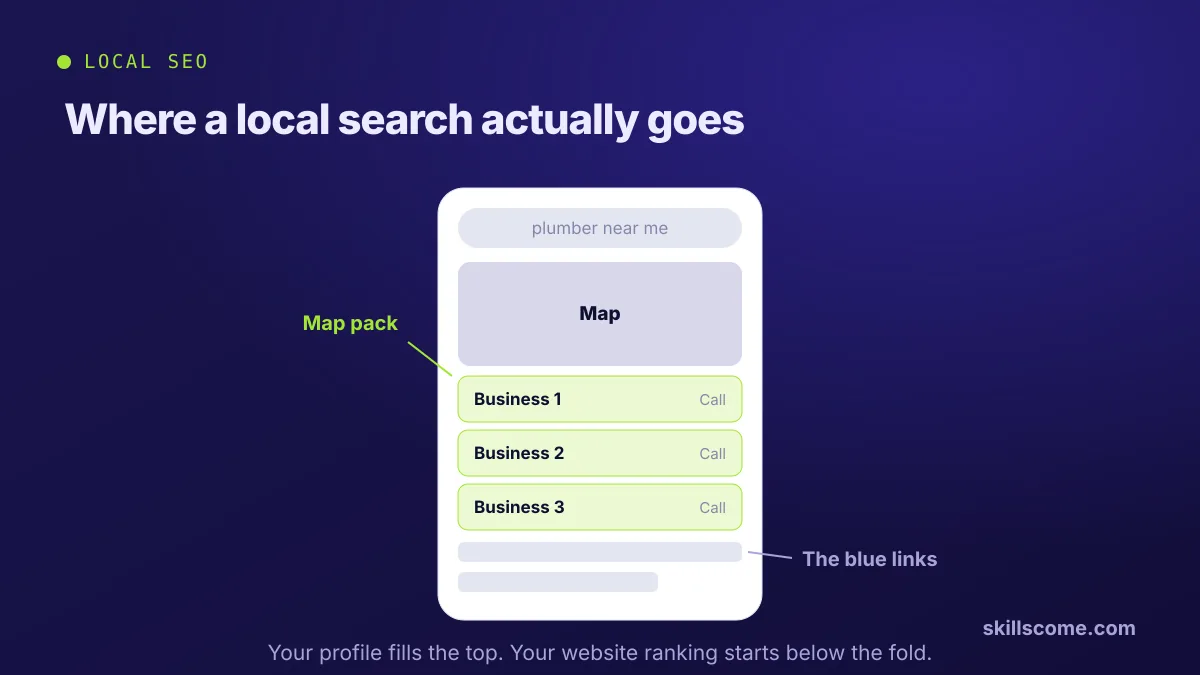
If people search for what you do and then travel to you, or you travel to them, local search is still where a large share of your customers decide. The map pack sits above the normal results on almost every local query, and it is filled by Google Business Profiles, not by websites.
So the question is not whether local SEO works. It is whether you are doing the part that actually fills those slots.
What actually changed
The map pack took the space
On a phone, a local search can fill the entire first screen with a map, three business listings and their buttons. A searcher taps call or directions without visiting any website at all. Your ranking at position four in the normal results is, in that moment, irrelevant.
AI answers absorbed the easy questions
Opening hours, whether you deliver, what a service costs roughly. Those queries used to bring a visit to your site. Increasingly they get answered above the results, from your profile and your pages, with no click. That looks like a traffic loss and is often a visibility gain, which is the pattern we wrote about in when a falling CTR is actually good news.
Proximity got stronger
Google weights how close the searcher is more heavily than it once did. That is why your business shows in the pack from your own office and not from across town, and why a ranking check from one location tells you almost nothing.
The consequence
For most local businesses the Google Business Profile is now more valuable than the website's ranking. Most profiles are half finished.
Who needs it and who does not
You need local SEO if:
- Customers come to a premises, or you go to them in a defined area
- People search your category with a place name, or search it while standing in that place
- Your competitors appear in the map pack and you do not
- You rely on phone calls and direction taps more than on form fills
You probably do not if:
- You sell online to anyone, anywhere, with no service area
- Your buyers are a small number of named companies you already know
- Your category is searched by problem rather than by place
Plenty of businesses sit in both camps. A store with a shop and a delivery operation needs the map pack for one audience and ordinary ecommerce SEO for the other.
A ten minute check
- Search your main service plus your town, on a phone, not logged in. Note what fills the first screen.
- Count how far down your site appears, and whether you are in the map pack at all.
- Open the profiles of the three businesses in the pack. Compare their categories, services, photos and review counts against yours.
- Check your own profile for gaps. Secondary categories, services list, attributes, products, recent posts. Most businesses have never filled half of these.
- Repeat the search from a different part of your service area. If you vanish, your reach is smaller than you think.
What to do first
In order, because this goes cheapest first and most businesses do it backwards.
- Finish the Google Business Profile. Every field. It is free, it takes an afternoon, and it affects the part of the page that gets the most attention. The specifics are in the fields nobody fills in.
- Get the business details identical everywhere. Name, address and phone, matching across every listing.
- Build a review habit that runs without you remembering it.
- Then the website. Proper pages for each service and each area you serve, written for people rather than stuffed with place names.
- Then links, local ones especially, from the trades, associations and press in your area.
If you serve an area rather than trading from a shopfront, the profile setup is different and has its own traps: creating a profile without a public address covers them.

Ijaz ul Haq
Founder of SkillsCome. Doing SEO since 2021, with 500+ SEO projects delivered and Top Rated status on Fiverr and Upwork. Runs and ranks his own stores in English, Spanish and Turkish.