In this article
Yes. If you serve customers at their location rather than at yours, Google calls that a service area business, and you can run a profile that shows a coverage area instead of a street address.
What you cannot do is have no address at all. Google still needs one for verification. It simply does not have to be displayed.
The short answer
During setup, when asked whether customers visit you, say no. You then enter your address for verification and tick the option to hide it, and set the areas you serve. The profile appears publicly with a service area and no street address.
This is a legitimate, supported profile type, not a loophole. Plumbers, electricians, mobile groomers, cleaners, tradespeople and consultants all use it.
What a service area business is
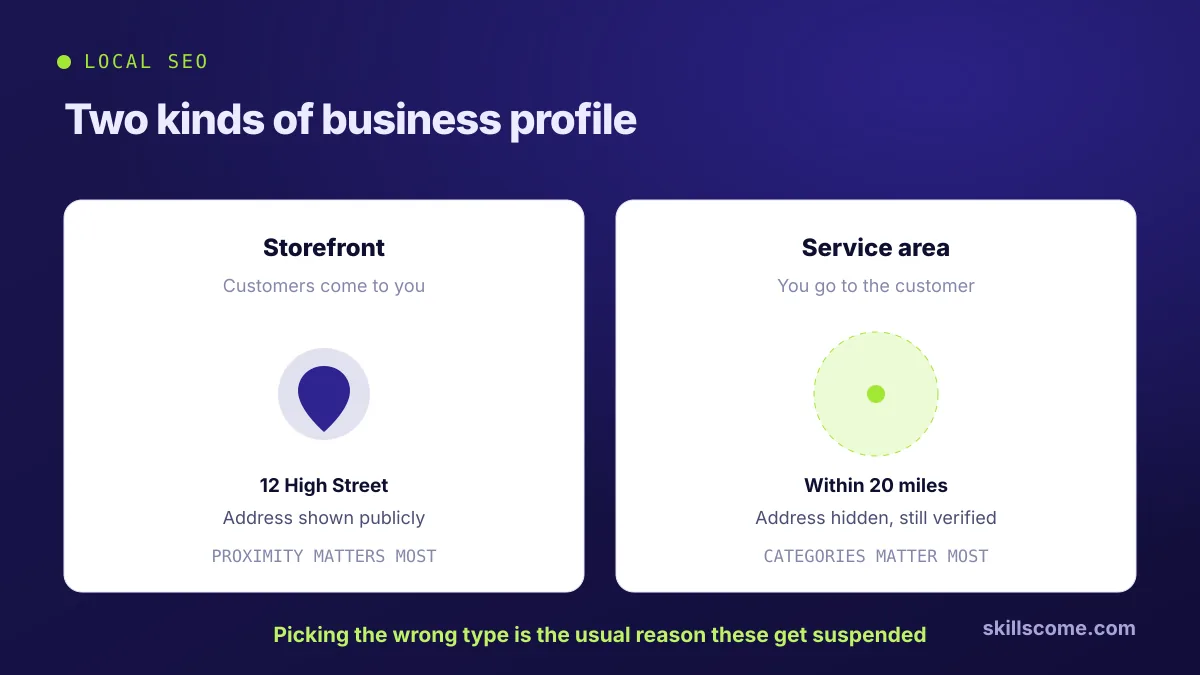
Google splits local businesses in two:
- Storefront. Customers come to you. The address shows, and proximity to the searcher matters heavily.
- Service area. You go to the customer. The address is hidden and a coverage area shows instead.
Some businesses are both, such as a workshop that also does call-outs. Those keep the address visible and add service areas on top. You do not need two profiles, and creating two is a good way to have both suspended.
How to set it up
- Start the profile and answer no when asked whether customers can visit your location.
- Enter your real address anyway. Usually your home or the place you work from. It is used for verification and is not published.
- Confirm it is hidden. After verification, check how the profile appears to the public, not how it looks in the dashboard.
- Set service areas honestly. Towns, cities or postcode areas you actually travel to. Twenty areas is the limit, and using all twenty is usually a mistake.
- Complete everything else. Primary category, secondary categories, services, hours, attributes, photos. These matter more for a hidden-address profile, not less, because you have fewer signals to work with. The list is in the fields nobody fills in.
On verification
Service area businesses are more likely to get video verification, where you show the premises, your tools, and evidence the business is real. Have signage, vehicle branding and equipment ready before you start.
What gets these suspended
Service area profiles are suspended more often than storefronts, and nearly always for the same handful of reasons.
- A virtual office or mailbox as the address. The quickest route to suspension. Google is good at recognising these addresses and they are explicitly not allowed.
- A coworking desk used purely as an address, with no staffed presence.
- Service areas far beyond what you serve. A one-van operation claiming an entire country is a flag.
- Multiple profiles for the same business at different addresses to cover more areas.
- Keywords in the business name. Your name is your name. "Smith Plumbing Emergency Plumber London" is a violation, and a common one.
- The address still showing somewhere else, such as on your own website or in directories, after you hid it.
If it has already happened, why profiles get suspended and how to appeal covers the recovery.
How ranking works without an address
This is the trade off nobody mentions at setup. Hiding the address costs you some proximity signal, because Google has less to work with when deciding whether you are near the searcher.
What you can control instead:
- Categories. The primary category does more for map pack ranking than almost anything else. Choose the most specific accurate one.
- Reviews that mention places. A customer writing that you came out to a named town is a strong, honest signal.
- Pages for the areas you serve, each carrying something real rather than a swapped place name. Keyword research for multiple locations covers which areas deserve a page.
- Consistent details everywhere, with the address hidden in the same way across every listing.
Expect to rank best nearest your verified address and to fade toward the edge of your area. That is normal, it happens to every service area business, and the honest fix is to be genuinely present where you claim to work.

Ijaz ul Haq
Founder of SkillsCome. Doing SEO since 2021, with 500+ SEO projects delivered and Top Rated status on Fiverr and Upwork. Runs and ranks his own stores in English, Spanish and Turkish.