In this article
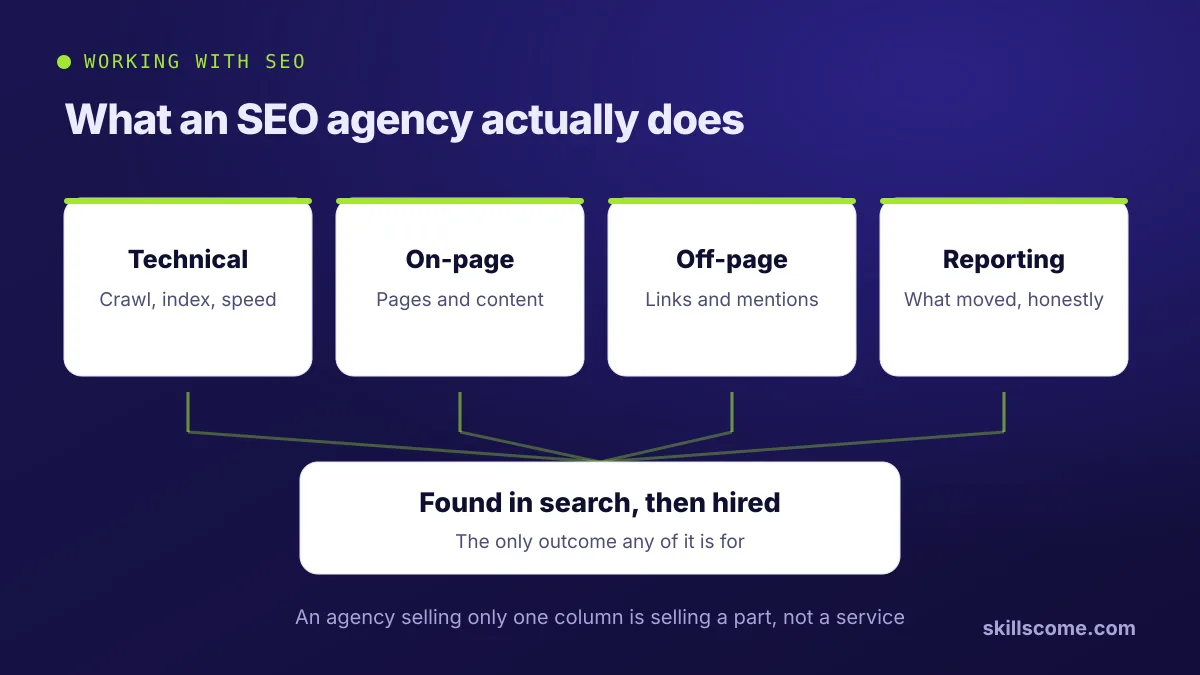
An SEO agency is hired to get a business found in search, and it does that through four kinds of work: fixing what stops Google reading the site, improving the pages themselves, earning links from other sites, and reporting honestly on what moved.
That is the whole category. Everything beyond it is either a specialism inside one of those four, or sales language.
The short version
You hire an agency when search is a channel your business needs and nobody in-house has the time or the knowledge to run it properly. The agency does the diagnosis, decides the order of work, does the work, and shows you what happened.
What it is not: a button that produces rankings, a monthly report that nobody reads, or a guarantee of position one. Anybody selling that last one is either guessing or using methods that will cost you later.
What the work consists of
Technical
Making sure Google can crawl, read and index the site. Indexing problems, slow pages, broken redirects, duplicate URLs, missing structured data. This is the unglamorous layer, and it is where the fastest wins usually sit because the problems are concrete and fixable. Our own write-up on pages that are not indexed covers the most common one.
On-page and content
Rewriting what you already have around what people actually search, and publishing what is missing. Titles, headings, page structure, and the questions buyers ask before they buy rather than generic industry filler.
Off-page
Earning links and mentions from other sites, because Google still uses them as evidence that somebody other than you thinks the site is worth reading. Done properly this is slow, manual and relationship driven. Done badly it is bought in bulk and causes problems later. We go through it in what off-page SEO is.
Measurement
Search Console and analytics, read properly. This is where an agency earns or loses trust, because the numbers either show progress or they do not, and both are worth knowing. A report that only shows the good lines is not a report.
What a normal month looks like
On a typical retainer, with a site that is already live:
- Week one: what changed since last month, in rankings, impressions and indexing. Any new errors picked up.
- Weeks two and three: the actual work. Pages rewritten, technical fixes shipped, outreach sent, placements confirmed.
- Week four: the report, and the plan for the following month based on what the data said rather than on a fixed template.
The first month is usually heavier on diagnosis and lighter on output, which is correct. An agency that starts publishing before it has read the site is guessing.
A fair expectation
Technical fixes can show up in four to eight weeks. Content and links take three to six months. Anyone promising page one in thirty days is selling something that costs more than it returns.
What it costs
Pricing varies enormously by market, and anyone quoting a single global number is wrong. What is consistent is the shape:
- Monthly retainers for ongoing work, scoped to the size of the site and how competitive the market is.
- One-time projects for an audit, a migration, or a rebuild.
- Per-unit work such as articles or link placements, bought as needed.
The thing to check is not the price but what is inside it. Twenty hours of real work costs what twenty hours costs, wherever the agency is based. A cheap retainer that produces three auto generated articles and a directory submission is not cheaper, it is a different product.
Our own numbers are public on the pricing page, including a builder where you can assemble a package and see the total, precisely so the conversation starts with real figures.
When you do not need one
Worth saying plainly, because it costs us work to say it.
- Your site is brand new and has almost no content. Build the pages first. SEO on an empty site is paying someone to optimise nothing.
- You sell to a handful of named clients. If your entire market is twenty companies, search is not your channel. Sales is.
- The business problem is not traffic. Plenty of sites get visitors and convert none of them. More traffic makes that worse, not better.
- You have the time and genuinely enjoy it. A focused owner working on their own site beats a disengaged agency every time.
How to tell a good one from a bad one
Three signals, in order of reliability.
- They tell you what they will not do. Any agency that has never turned work down is not making judgements.
- They show you evidence you can verify. A live screen share of a Search Console account beats any case study PDF.
- They talk about your business before they talk about keywords. The right terms come from knowing who buys and why, not from a volume column.
If you are at the stage of picking one, how to choose an SEO agency has the questions worth asking, including the ones most agencies hope you will not.

Ijaz ul Haq
Founder of SkillsCome. Doing SEO since 2021, with 500+ SEO projects delivered and Top Rated status on Fiverr and Upwork. Runs and ranks his own stores in English, Spanish and Turkish.