In this article
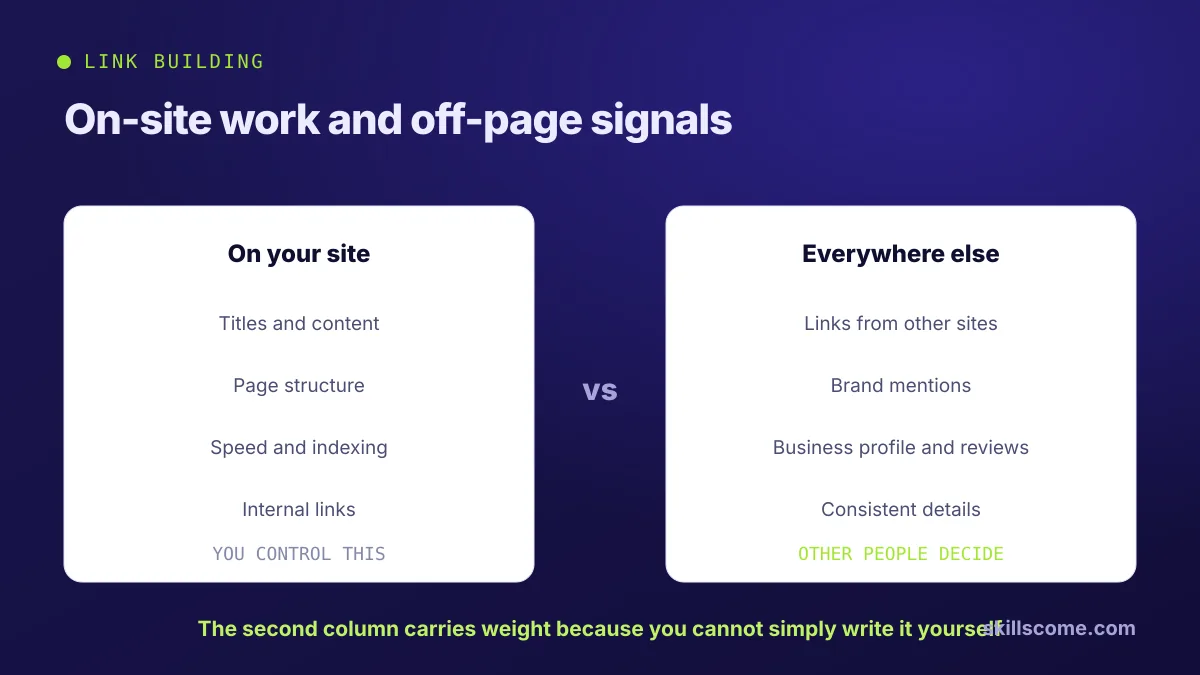
Off-page SEO, sometimes written off-site SEO, is everything you do away from your own website to help it rank. On-page work is what you control directly. Off-page work is what other people do, which is precisely why search engines give it weight.
What it means
The split is simple. Change a title tag, that is on-page. Fix an indexing problem, that is technical. Get an industry publication to mention you, that is off-page. The first two you can do alone. The third requires somebody else to decide you are worth mentioning, and that is the signal.
What actually counts
In rough order of weight for most businesses:
- Links from relevant sites. Still the core of it, and still the hardest to get honestly.
- Brand mentions, with or without a link. Being written about consistently is itself evidence of a real business.
- Your Google Business Profile, for anything local. For a local business this often outweighs everything else, because the map pack sits above the normal results.
- Reviews, in volume and recency, on the platforms your buyers check.
- Consistent business details across directories, associations and profiles. Name, address and phone matching everywhere.
- Where people discuss your category, which increasingly means forums, communities and video, because those are the sources answers get drawn from.
Why links still lead
Because a link is a costly signal. Writing a sentence about a company is free, but putting a link in an article you are responsible for carries a small reputational cost, so it carries information.
What has changed is the weighting inside links. Volume mattered more a decade ago. Relevance matters more now. Ten links from sites in your niche with real readers beat a thousand from a network that links to everything, and the second set can actively hold you back. The reasoning is in how many backlinks you need to rank.
The practical test
Would the link still be worth having if search engines did not exist, because real people would click it? If yes, it is a good link. If no, you are buying a number.
What else is off-page
Google Business Profile and local signals
For anyone serving a physical area this is the single highest return off-page work there is, and most profiles sit half finished. We went through the fields that matter in the Google Business Profile fields nobody fills in.
Reviews
They influence both ranking and whether anyone clicks. A steady flow matters more than a high average from three years ago.
Entity consistency
The same business name, description and details wherever you appear. This is unglamorous, it never shows up in a case study, and it quietly decides whether search engines treat you as one business or three.
Unlinked mentions
Being named in articles without a link still counts for something, and they are often the easiest links to convert, because the writer already decided you were worth mentioning.
What does not work any more
- Bulk directory submissions. Five hundred listings on sites nobody visits.
- Comment and forum signature links. Nofollowed, ignored, and visible to anyone checking your profile.
- Private blog networks. They work until the network is identified, then they stop working all at once.
- Article spinning. One piece rewritten by software and placed on fifty sites, all of which Google has already seen.
- Buying by the thousand. The arithmetic never worked. It just took a while to become obvious.
If a profile has already collected a lot of this, usually without the owner's involvement, toxic backlinks and when to disavow covers what to do, and the answer is often nothing.
Where to start
In this order, because it goes from cheapest to hardest:
- Fix the free things. Google Business Profile completed properly, details consistent everywhere, a review habit that actually runs.
- Find who already links to your competitors. A backlink gap analysis gives you a warm list in an afternoon.
- Earn a small number of relevant links, steadily, and record every one.
- Keep the list from rotting. Managing backlinks is a monthly habit, not a one-off.
That order matters. Most sites skip straight to step three, which is the expensive one, and leave the free wins untouched.

Ijaz ul Haq
Founder of SkillsCome. Doing SEO since 2021, with 500+ SEO projects delivered and Top Rated status on Fiverr and Upwork. Runs and ranks his own stores in English, Spanish and Turkish.