In this article
No, a .gov or .edu link does not carry extra weight because of its extension. Google has stated this more than once, most plainly in the context of people asking whether to chase them. There is no multiplier attached to a top level domain.
The belief is stubborn, though, and there is a whole market built on it, so it is worth understanding why it survives.
The short answer
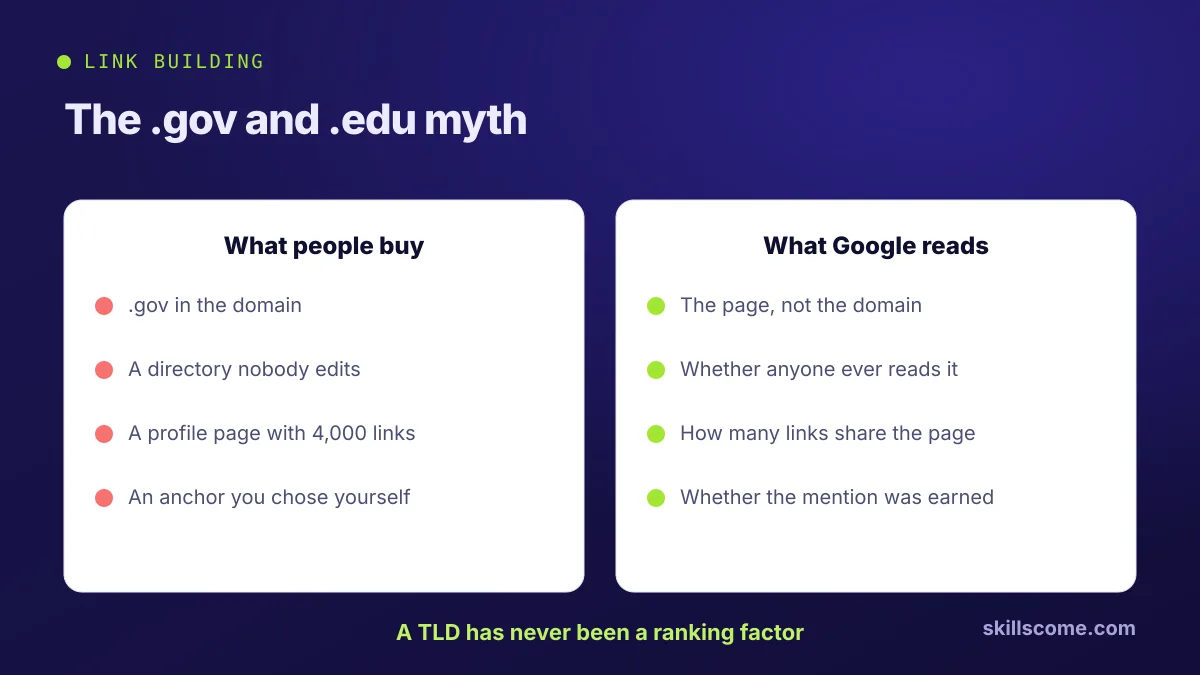
A link from a university page is evaluated the same way as a link from anywhere else: is the page relevant, does it have standing, is the link editorial, and how many other links share the page. A .edu page with 4,000 outbound links in a student directory is a weak link that happens to end in .edu.
Meanwhile a genuine mention from a respected trade publication in your industry, on a .com, can be one of the strongest links you will ever get.
What Google has said
There is no ranking boost attached to .gov or .edu. The extension tells Google who registered the domain, not whether the page is worth anything.
Where the belief came from
It is not pulled from nowhere. For a long stretch, government and university sites genuinely did tend to be old, heavily linked and carefully maintained, so links from them correlated with good outcomes. Correlation got reported as causation, the idea entered every SEO forum, and it never left.
What changed is that the correlation weakened. Universities now run thousands of pages across departments, student societies, personal staff pages and forgotten subdomains, many of which are abandoned or compromised. The average quality of a page ending in .edu is nothing like it was.
What is actually being sold
When somebody offers you ".edu backlinks, 20 for a fixed price", you are almost always buying one of these:
- Profile pages on a university forum or learning platform, where anyone can register and add a website field. No editorial decision was made. Usually nofollowed, often deindexed.
- Comment links on an unmoderated department blog that nobody has looked at since 2014.
- Resource page insertions obtained by exploiting a form, rather than by being a resource.
- Hacked pages on a neglected subdomain. These get cleaned, and the link vanishes along with whatever you paid.
None of these are editorial mentions, which is the only kind of link the whole system is built to reward. The extension is doing the selling, and the page is doing nothing.
When one is genuinely worth having
There are real cases, and they look nothing like the packages.
- A scholarship or grant you actually fund, listed on a university's own financial aid page. Legitimate, but expensive, and only honest if the scholarship is real and awarded.
- Research or data you published that a department cites because it is useful to their students.
- A local council page listing businesses in a scheme you genuinely participate in, such as a trade register or an accreditation.
- A supplier or partner relationship with a public institution that already exists offline.
In every one of these the link is a side effect of a real relationship. That is also exactly why it counts.
What to do instead
Spend the same money on links from sites your buyers actually read. Ten mentions on trade publications, supplier blogs, local news and industry roundups in your niche will outperform any bundle of institutional profile pages, and they will survive the next clean up.
If you want the reasoning behind that trade off, how many backlinks you need to rank covers how relevance beats volume, and what a backlink profile is made of explains why a profile full of unrelated institutional links looks odd rather than impressive.
Our own approach is set out on the off-page page: manual placements, niche relevance first, and every live URL reported so you can check the page yourself rather than trusting a line in a spreadsheet.

Ijaz ul Haq
Founder of SkillsCome. Doing SEO since 2021, with 500+ SEO projects delivered and Top Rated status on Fiverr and Upwork. Runs and ranks his own stores in English, Spanish and Turkish.