In this article
Negative SEO means trying to damage someone else's search rankings on purpose. Usually it means pointing a lot of spam links at their site.
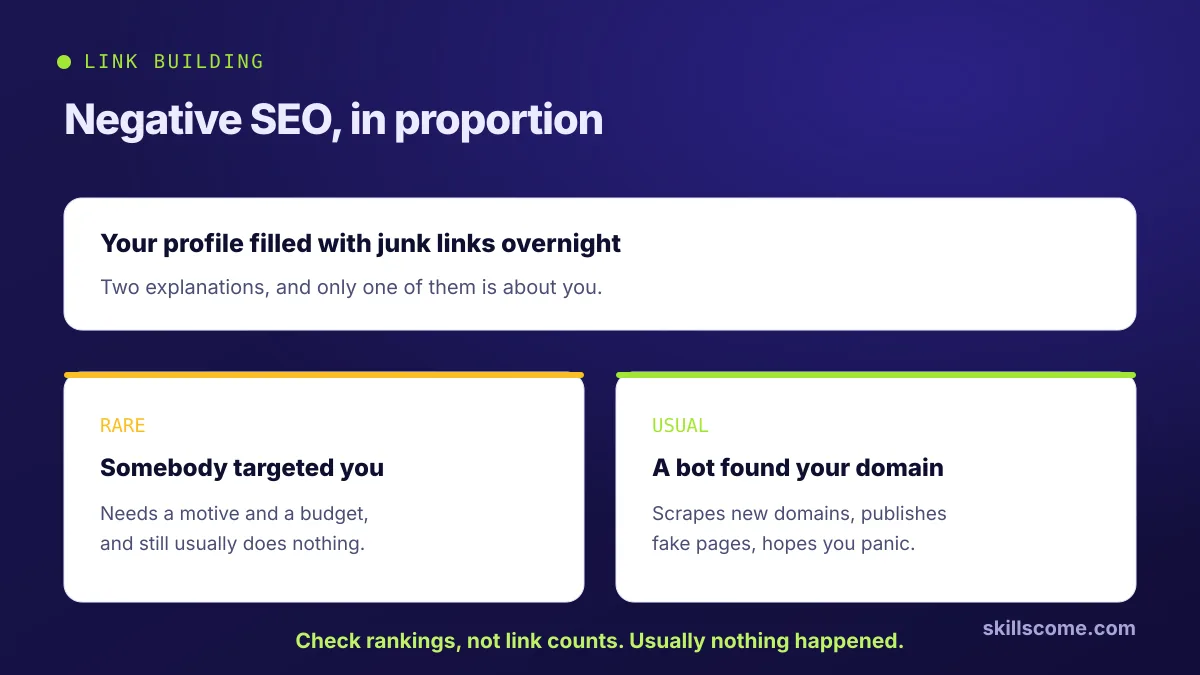
It rarely works, and if your backlink profile has suddenly filled with junk, the overwhelming likelihood is that nobody targeted you at all.
The short answer
Google has spent years building systems to ignore spam links, for the obvious reason: if cheap links could sink a competitor, every business online would be attacking every other business and the results would be worthless.
So links you did not build are, in almost every case, already discounted. Doing nothing is usually correct, and that is not complacency, it is the documented position.
What people mean by it
- Link spam. Thousands of links from link farms, gambling and pharmacy sites, and auto generated pages. By far the most common thing people see.
- Scraped content. Your pages copied and republished elsewhere.
- Fake reviews. A burst of bad reviews on a profile, which is a real problem for local businesses and quite separate from links.
- Hacking. Injecting spam pages or redirects into a site through a security hole. This one genuinely works, and it is not really SEO, it is a breach.
- Fake takedown requests filed against your pages.
Only two of those should worry you, and they are the last two.
Why link spam rarely works
Because the pages doing it are worthless by every measure Google already uses. They have no readers, no links of their own, thousands of outbound links each, and a footprint Google has seen millions of times. A signal from a source with no credibility carries no weight in either direction.
The exception is a site that was already relying on bought links. If your own profile is mostly purchased placements, a flood of additional spam can push an already fragile pattern over a line. The vulnerability there came from your own link building, not from the attacker.
The test
Did your rankings actually change? Not your backlink count. Traffic and position. If those are steady, nothing happened, whatever the tool's toxicity score says.
What can genuinely hurt you
- A hacked site. Spam pages, hidden links or redirects injected into your own site. This causes real damage fast, and it shows up in Search Console under Security Issues.
- Review attacks on a Google Business Profile, which affect both ranking and whether anyone calls.
- Scraped content that outranks you, which is rare but possible on a weak site.
- Your own past link buying, surfacing later. This is the most common real cause of the damage people blame on attackers.
What it looks like in practice
This site is a useful example, because it happened here. Within days of launching, the profile showed 146 links from 131 referring domains, all first seen before the site existed. Gambling domains, pharmacy spam, Turkish escort sites, and dozens of auto generated pages with templated titles, each carrying five thousand outbound links and an authority score of zero. There were even fake testimonial pages claiming the domain had improved somebody's bounce rate by a precise percentage.
It looks like an attack. It is not. These networks generate pages by scraping newly registered domain names, publishing them as fake reviews, and hoping somebody panics and buys a cleanup service. Every new domain gets some of this.
Rankings were unaffected, because there were no rankings to affect, and because Google ignores this kind of thing by default.
What to actually do
- Check Search Console first. Manual Actions and Security Issues. If both are clean, nothing has gone wrong, whatever a third party tool says.
- Compare traffic and position, not link counts. A profile full of junk with flat traffic is a cosmetic problem, not a ranking one.
- Secure the site properly. Updates, strong passwords, two factor authentication. The one attack that genuinely works is the one that gets inside.
- Leave the links alone unless you built them. The disavow tool exists for links you are responsible for, as covered in toxic backlinks and when to disavow.
- Disavow anyway only for reputation, if clients will look at your profile in a tool, and be clear with yourself that it is a reputation decision rather than a ranking one.
- Keep building real links. The strongest defence against a junk profile is a good one around it. A backlink gap analysis is the fastest place to start.

Ijaz ul Haq
Founder of SkillsCome. Doing SEO since 2021, with 500+ SEO projects delivered and Top Rated status on Fiverr and Upwork. Runs and ranks his own stores in English, Spanish and Turkish.